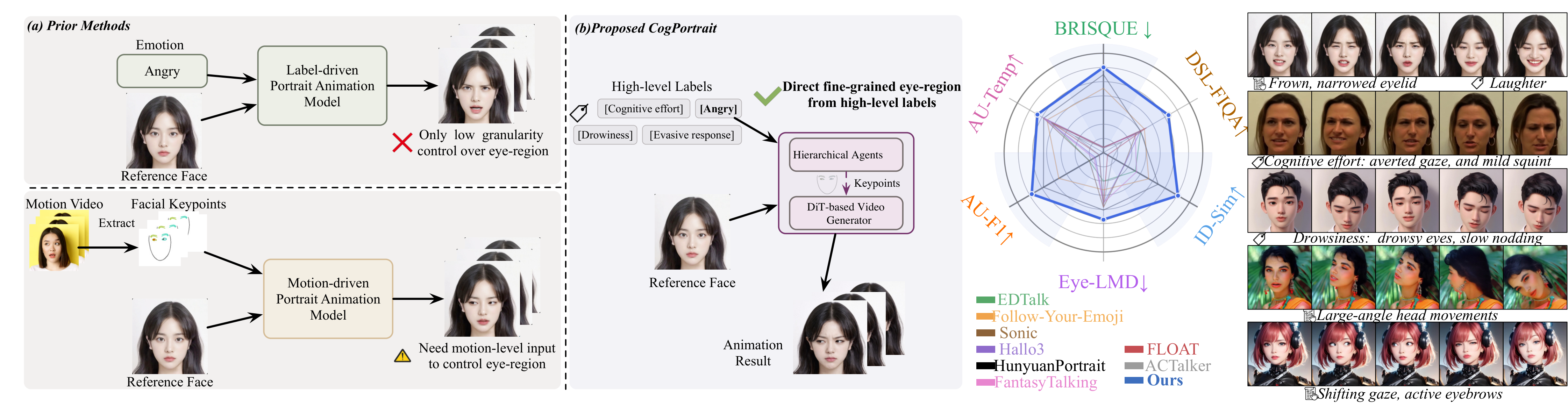
TL;DR: CogPortrait generates portrait animations with fine-grained eye-region control from high-level labels. A three-agent MLLM pipeline compiles labels into facial keypoints via temporal event planning, prototype retrieval, and physiological constraint enforcement. A DiT-based backbone with dynamic CFG and KTO refinement synthesizes the final video. The EMH benchmark covers 12 categories (6 emotions + 6 beyond-emotion states) with AU-level metrics for evaluating eye-region and head-motion control.

Abstract

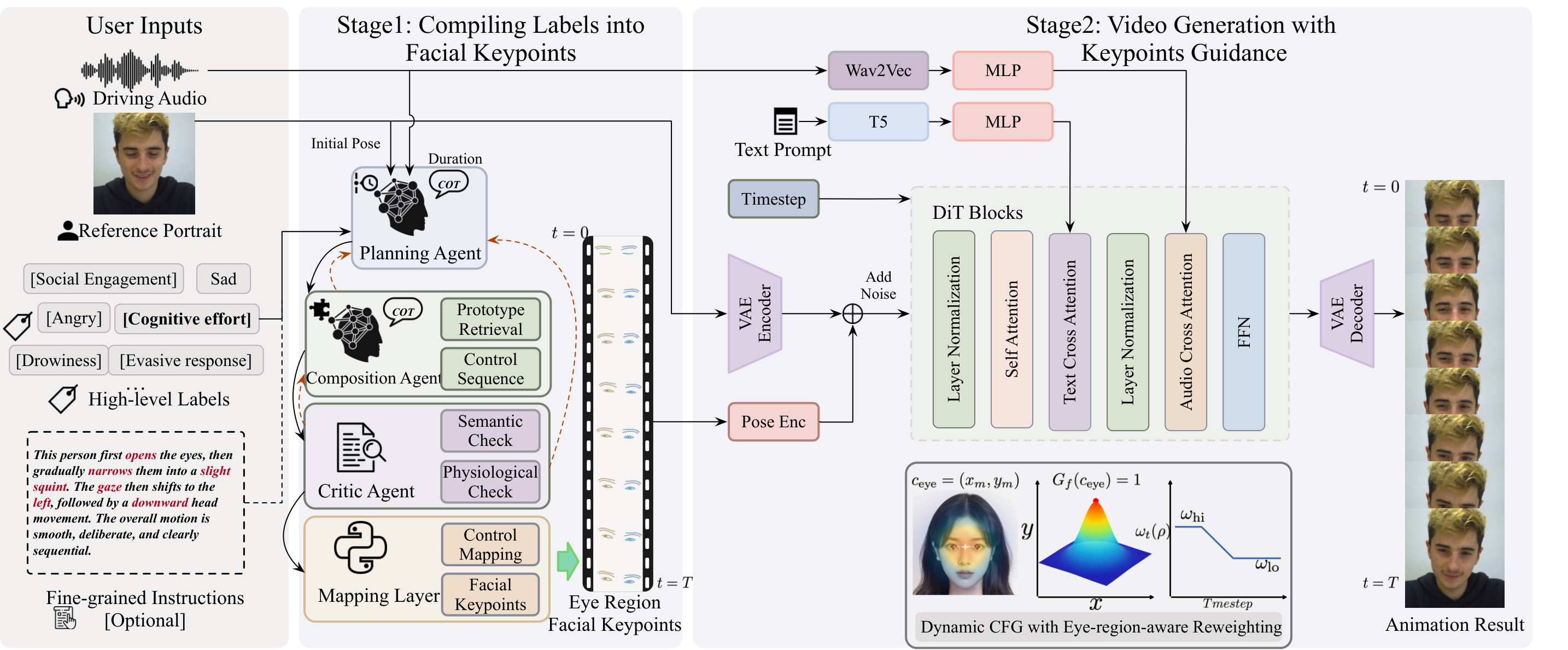
Portrait animation methods have achieved substantial visual quality and lip synchronization, but fine-grained manipulation of the eye region still faces a trade-off between input granularity and motion accuracy. Existing methods using emotion labels or coarse text prompts are insufficient for describing subtle ocular dynamics, whereas approaches based on Action Units or driving videos provide higher fidelity at the cost of a heavier input burden. These limitations are still restrictive for beyond-emotion states (e.g., thinking) and drowsiness. In light of the above, we propose CogPortrait, a two-stage framework that generates portrait animations from high-level labels. In the first stage, three chain-of-thought Multimodal Large Language Models (MLLMs) agents compile high-level labels into facial keypoints through temporal event planning, prototype retrieval and composition from a real-behavior library, and semantic-physiological constraint enforcement. In the second stage, a DiT-based video generation backbone synthesizes the final animation conditioned on the keypoints, reference portrait, audio, and text prompt, enhanced by a dynamic classifier-free guidance strategy with eye-region-aware reweighting and KTO-based refinement for boundary cases. We further introduce the EMH benchmark covering diverse emotions and beyond-emotion categories with two AU-level metrics for evaluating fine-grained eye-region and head-motion control. Extensive experiments on HDTF and the EMH benchmark demonstrate that CogPortrait achieves more precise eye-region control than existing methods while maintaining superior visual quality and identity consistency.

Motivation & Overview

CogPortrait Overview

Figure 1. Left: comparison of prior label-driven and motion-driven methods with CogPortrait, highlighting direct fine-grained eye-region control from high-level labels. Center: radar-chart comparison with baselines on the EMH benchmark, where larger areas indicate better performance. Right: OOD cases generated by CogPortrait, including fine-grained instruction, laughter, cognitive effort, drowsiness, large-angle head movement, and control of gaze and eyebrow motion.
Technical Pipeline

CogPortrait Pipeline Architecture

Figure 2. Overview of the proposed CogPortrait framework. Stage 1 compiles a high-level label, a reference portrait, and optional fine-grained instructions into facial keypoints through four layers: Event Planning, CoT Composition Agent (prototype retrieval), Critic Agent (semantic-physiological checks), and a Mapping Layer (keypoint projection). Stage 2 generates the final portrait animation from the reference portrait, driving audio, a text prompt, and the facial keypoints via a DiT-based backbone with dynamic CFG and eye-region-aware reweighting, refined by KTO for boundary cases.

Results

Quantitative Comparison on HDTF

MethodFID ↓FVD ↓LPIPS ↓Sync-C ↑ID-Sim ↑Eye-LMD ↓
EDTalk98.77142.880.17495.670.83360.0210
Follow-Your-Emoji18.2272.110.09294.830.86090.0173
Sonic24.6651.650.10757.430.86090.0363
Hallo353.8545.760.18855.920.86220.0255
HunyuanPortrait18.6839.790.09626.220.88370.0293
FantasyTalking44.7951.460.08876.950.89570.0346
FLOAT72.7799.250.26766.920.76510.0781
ACTalker27.9237.640.19347.020.86510.0217
Ours16.6832.900.06337.150.92140.0107

Performance on the EMH Benchmark

MethodBRISQUE ↓DSL-FIQA ↑ID-Sim ↑Eye-LMD ↓AU-F1 ↑AU-Temp ↑
EDTalk49.740.38380.86010.03130.54490.5255
Follow-Your-Emoji47.520.41440.88430.02370.88160.6936
Sonic52.590.47610.90440.03950.57070.5249
Hallo350.150.46250.89640.03930.54870.4566
HunyuanPortrait49.800.48590.90190.01920.91450.7475
FantasyTalking53.210.45980.90670.03050.55540.4758
FLOAT46.330.47100.85800.07460.52970.3251
ACTalker61.170.46860.73080.05340.52120.3188
Ours (GT)32.840.51920.93620.01120.93030.7830
Ours (Inverted)32.730.52660.92170.01330.91920.7791
Ours (Full)34.200.51840.91290.01450.90170.7397

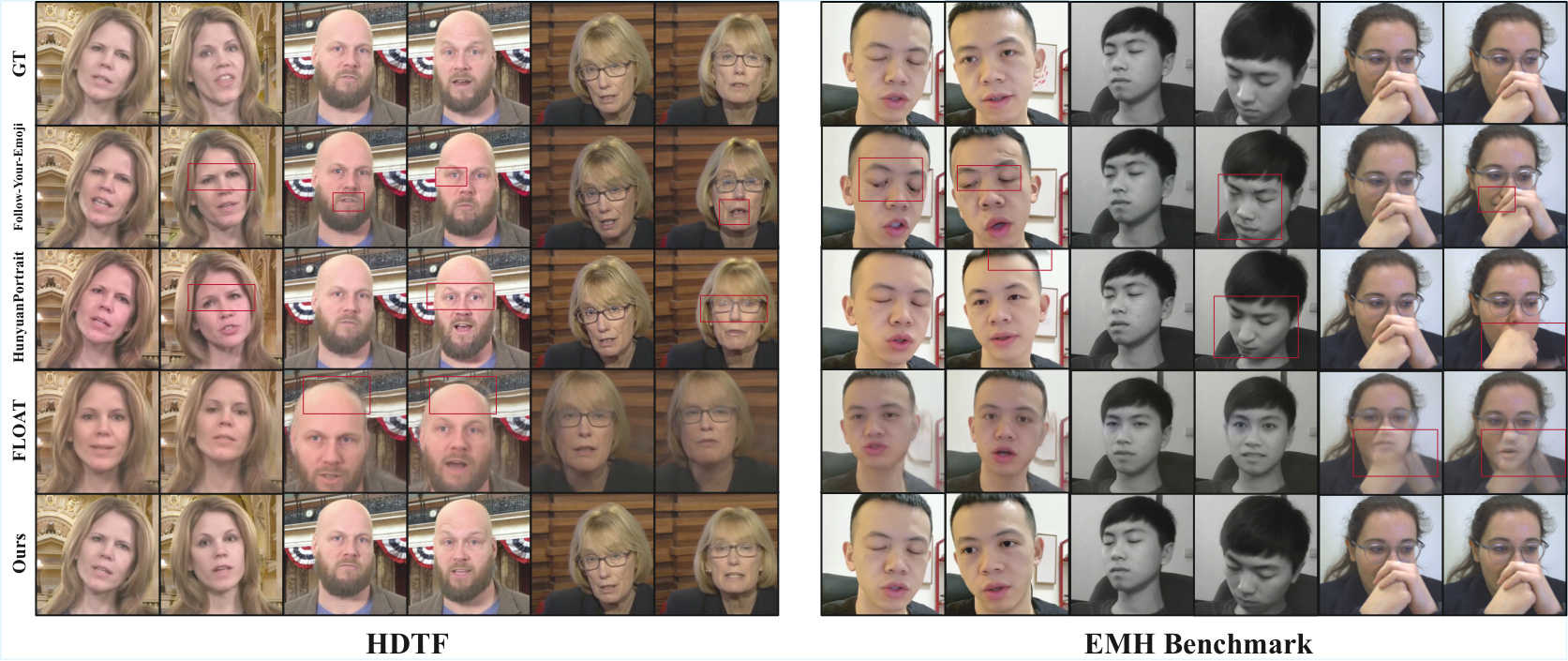
Qualitative Comparison

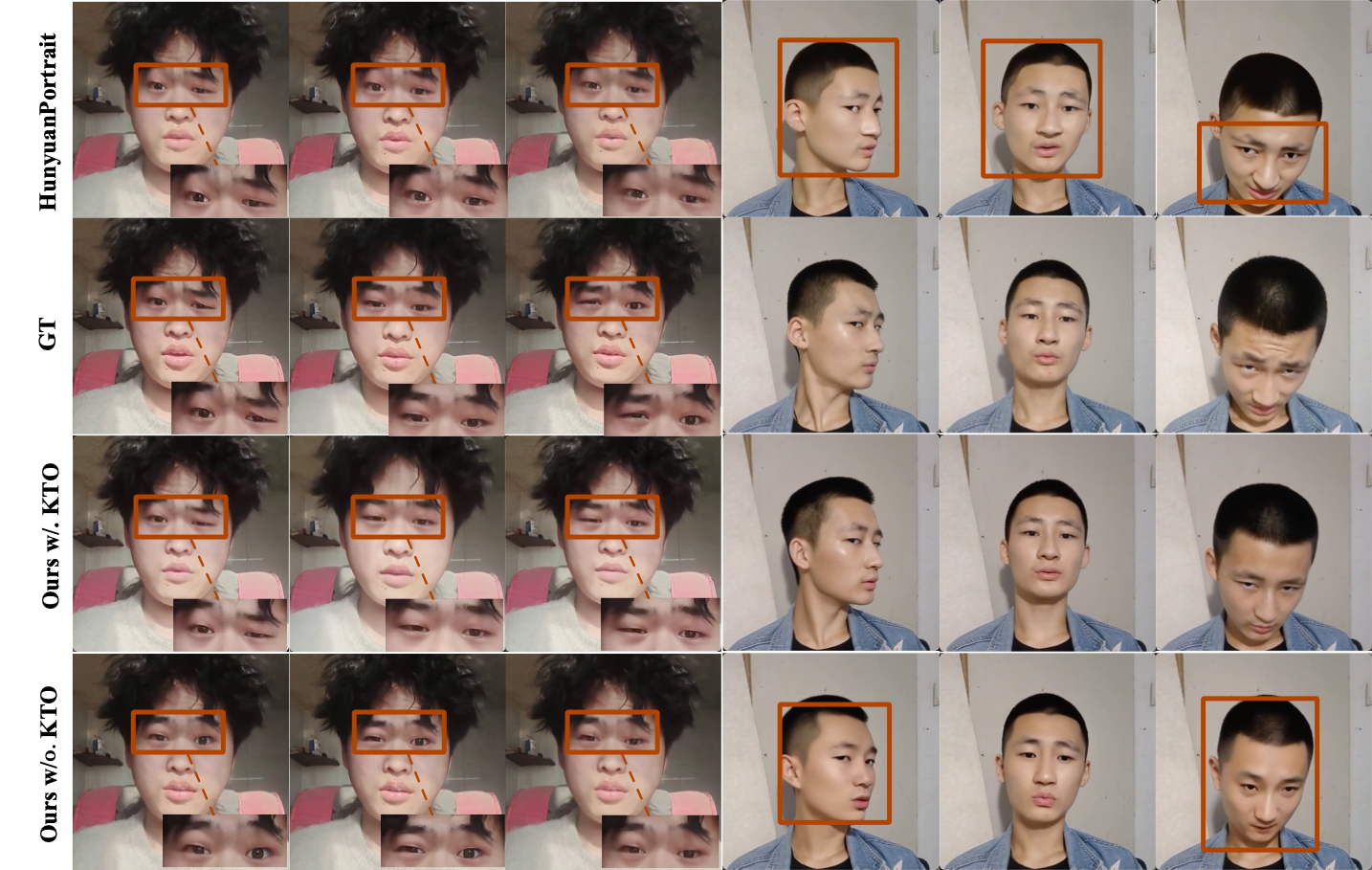
Comparison on HDTF (left) and the EMH benchmark (right) against representative baselines. Red boxes highlight typical failure cases. Zoom in for details.

Qualitative Comparison

Ablation Study: Dynamic CFG Strategy

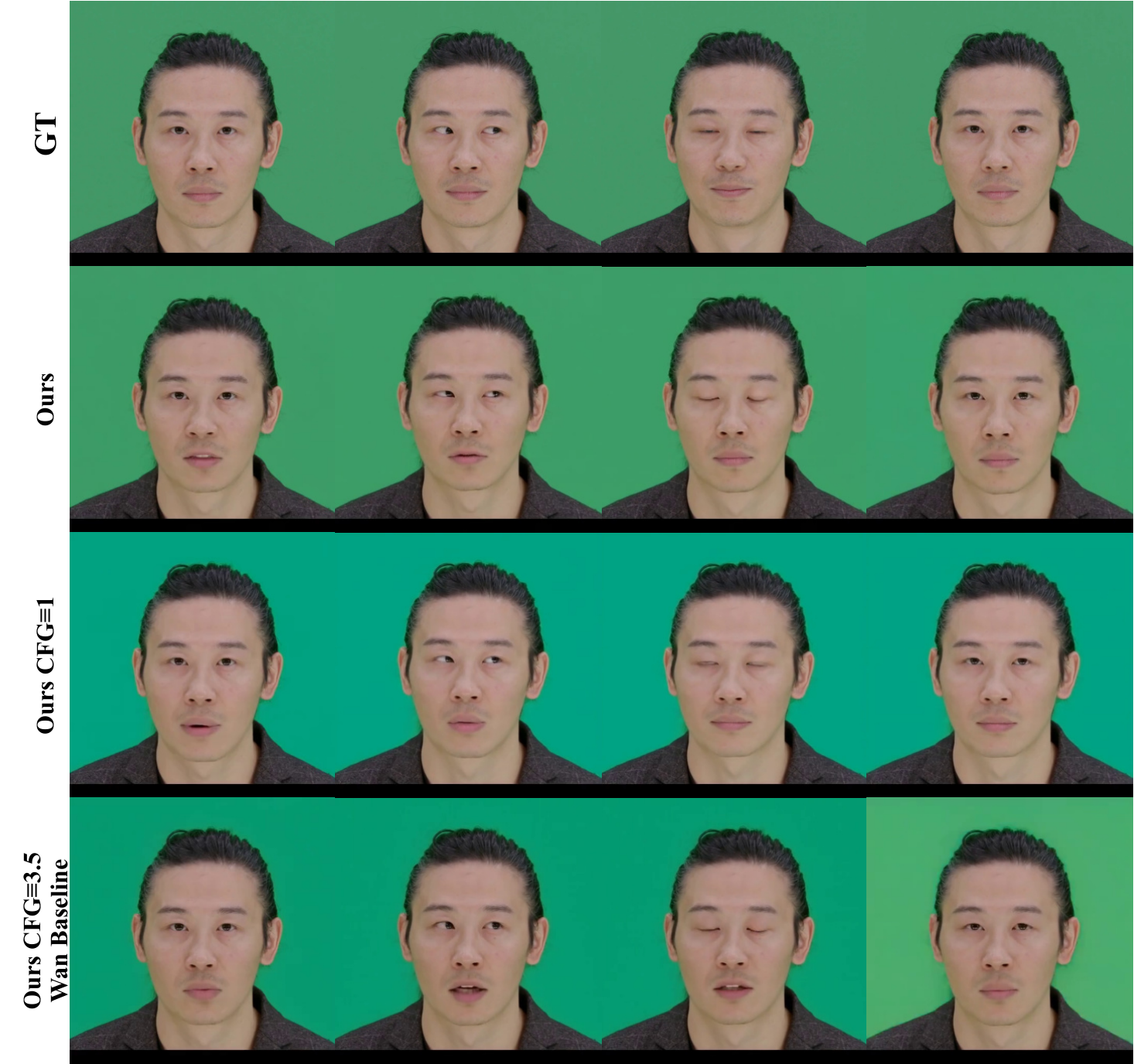
Comparison of CFG strategies on images with pure green backgrounds. A single global CFG scale causes undesired color shift in both background and facial regions, while our dynamic CFG with eye-region-aware reweighting alleviates this issue.

CFG Ablation

Ablation Study: KTO Refinement

KTO refinement on asymmetric eyebrow control and identity consistency under large-angle head movements. Red boxes highlight key local regions.

KTO Ablation

EMH Benchmark Overview

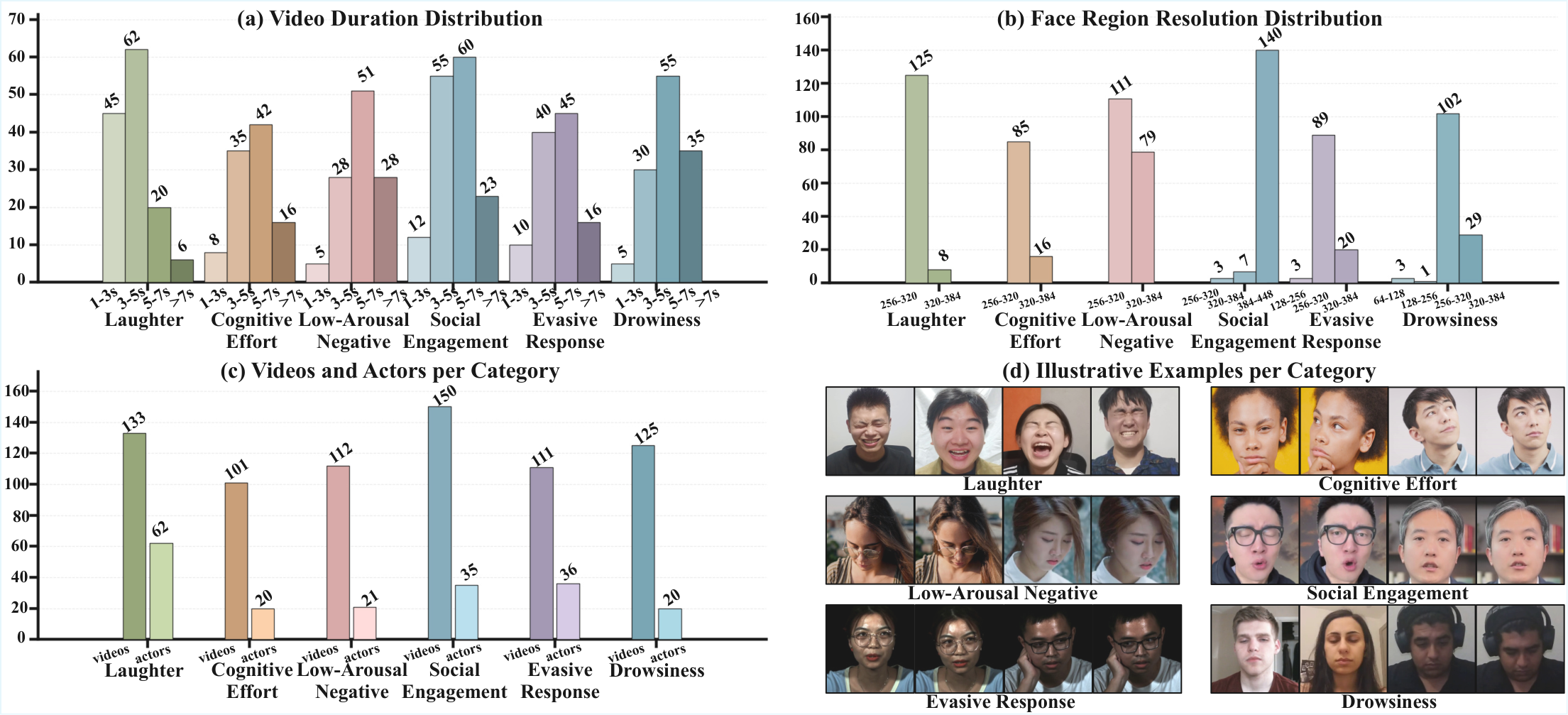
The EMH benchmark contains 12 categories (6 core emotions + 6 beyond-emotion states) with video-duration distribution, face-region resolution distribution, and representative samples across categories.

EMH Benchmark

Ablation Study: Quantitative Results

VariantBRISQUE ↓DSL-FIQA ↑ID-Sim ↑Eye-LMD ↓AU-F1 ↑AU-Temp ↑
Stage-1 Ablation
Direct label-to-keypoints40.250.40920.88030.02530.85350.5676
Rule-based retrieval39.310.44880.88170.02240.88120.5899
Agent 1 only36.780.47850.88340.01950.83460.7112
Agent 1 + Agent 2 w/o Critic34.830.50810.89320.01730.88210.7135
Stage-2 CFG Ablation
Fixed CFG (s=3.5)34.730.50620.88760.02070.88230.7275
Temporal reweighting only34.510.50780.90730.01930.88350.7301
Spatial reweighting only34.350.51390.89450.01580.89030.7368
Full Pipeline34.200.51840.91290.01450.90170.7397

Supplementary Videos

Citation

@misc{feng2026cogportrait,
    title={CogPortrait: Fine-Grained Eye-Region Control in Portrait Animation via Hierarchical Agent Planning},
    author={He Feng and Yongjia Ma and Donglin Di and Lei Fan and Tonghua Su},
    year={2026},
    eprint={2605.28056},
    archivePrefix={arXiv},
    primaryClass={cs.CV}
}